Response time matters in customer service, sales and support. Delays can frustrate users, leave opportunities unanswered and overload internal teams. AI agents can help with repeated questions, classification, information retrieval and handoffs.
The aim is to help each request move forward with less waiting and manual work. Speed is useful only when the information is correct and the next step is appropriate.
Why response times matter
When someone asks about a product, order, service or problem, they need timely guidance. Long waits can lead customers to seek alternatives, increase backlogs and reduce service quality as teams become overloaded.
This is particularly noticeable on WhatsApp, web chat and social channels. In sales, a delay can mean a missed lead; in support, more frustration; in administration, repeated follow-up messages. Consider delays throughout the journey, not only the first reply.
What AI can accelerate
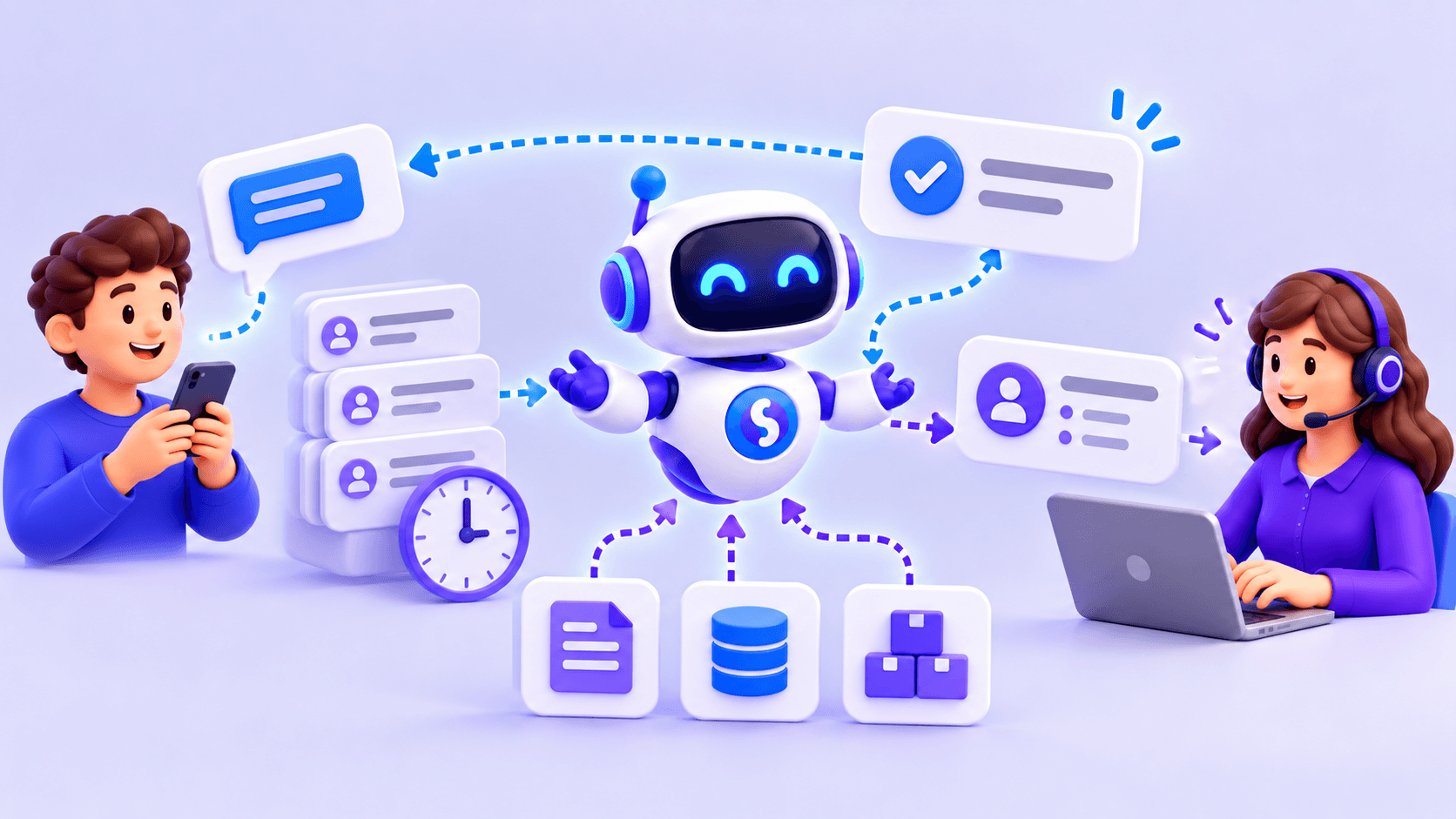
An agent can answer common questions, identify intent, request missing details, search documents, query systems, classify conversations, route requests, assist operators and provide information outside working hours.
Define what it may resolve and when it must escalate. A fast acknowledgment is different from a useful answer or a completed resolution.
Where delays come from
Repeated questions
Teams repeatedly answer questions about hours, prices, availability, terms, documents, orders and requirements. Clear, frequent questions are often useful automation candidates.
Scattered information
An operator may know how to answer but need to search a spreadsheet, PDF, catalog, CRM, management system or earlier conversation. The delay lies in finding the information.
Manual routing
Requests sent to the wrong department must be read and forwarded, adding another wait.
Missing customer details
A name, order number, company, product or reason for contact may be needed before work can begin. Collecting the necessary details earlier can reduce extra exchanges.
Limited service hours
Requests arriving outside working hours may wait until the next day. An agent can provide supported answers or organize the request while clearly explaining when a person will be available.
How agents can help
1. Answer common questions
An agent can provide approved payment methods or opening hours without waiting for an operator, provided the source is clear and current.
2. Retrieve documentation
It can search knowledge bases, manuals, policies or internal documents and return relevant requirements or instructions.
3. Query business systems
Configured integrations can retrieve stock, prices, order status, customer records, invoices, appointments, tickets or request status. This reduces manual navigation between systems.
4. Classify conversations
The agent can help route requests to Sales, Support, Administration, Collections, Logistics or Warranty teams.
5. Prepare a handoff
When a person is needed, the agent can collect necessary information such as the company, contact details and product. The operator receives a more complete request.
6. Assist operators
AI does not always need to answer the customer directly. It can suggest responses, summarize a conversation or retrieve relevant information for a person to review.
Practical example: a product request
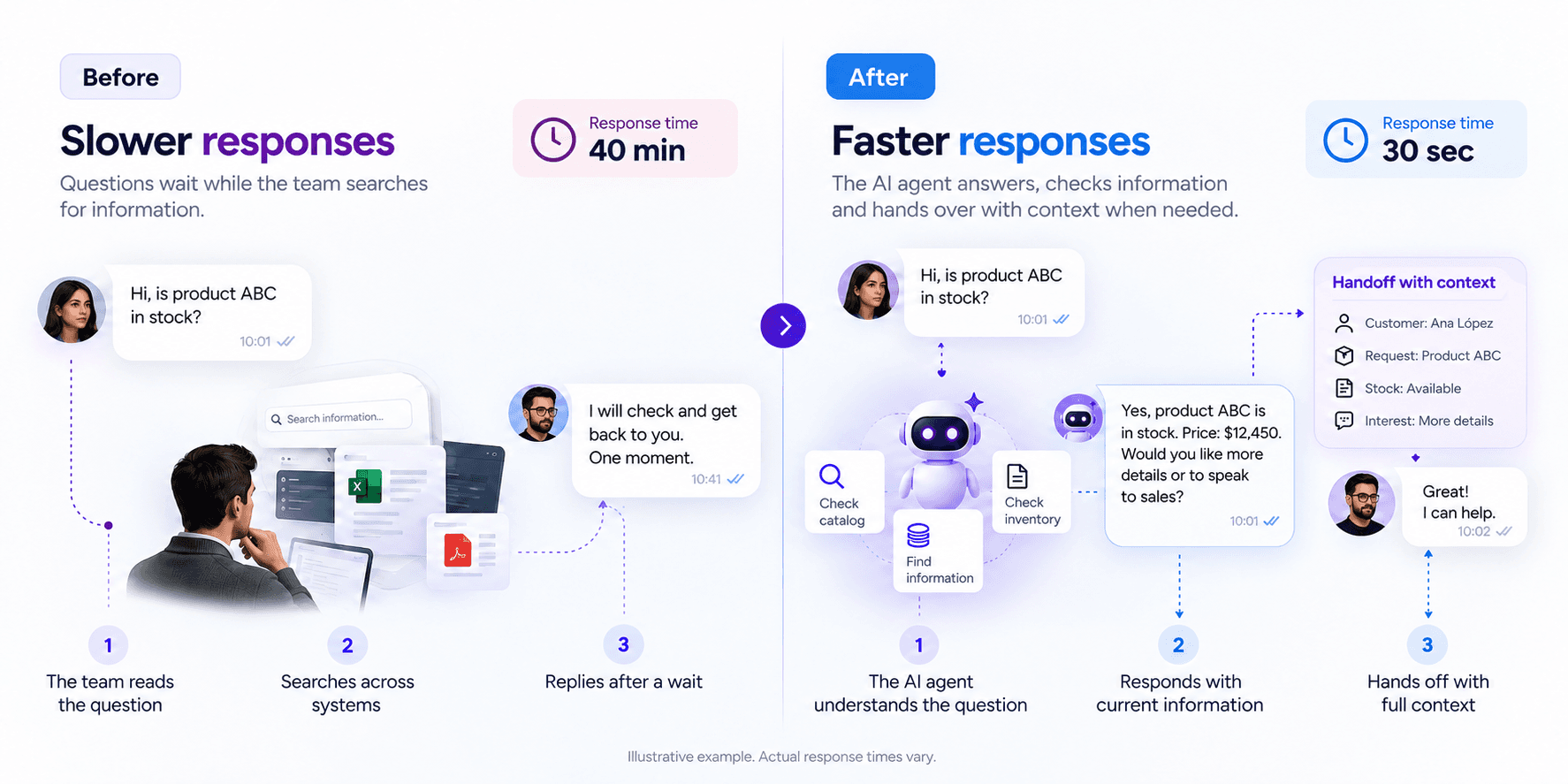
In a manual process, a customer asks about a product, a salesperson reads the message when available, searches the catalog, checks stock and price, responds and asks again if details are missing.
An agent could identify the product, clarify missing details, retrieve availability, provide initial information and gather context before handing the request to Sales. The salesperson remains part of the process but receives a better-prepared conversation.
The time saved depends on the actual workload, systems and implementation; an illustrative sequence is not a measured performance claim.
Which answers should be automated?
Start with frequent requests supported by clear information and limited need for judgment: FAQs, general commercial information, requirements, hours, payment methods, instructions, routing and data collection. Stock and order questions also need reliable current sources and appropriate authorization.
Sensitive complaints, negotiations, exceptions, approvals, disputes, legal matters and requests missing critical information should be supervised or handed over.
Metrics for response times
First-response time
Measure the time from the user's initial message to the first reply. Distinguish a generic acknowledgment from substantive help.
Resolution time
Measure how long the whole request takes to resolve. Faster first replies do not necessarily improve this if information and handoffs remain poor.
Automatic resolution rate
Track how many conversations are resolved without a person, together with accuracy and satisfaction. More automated answers are not useful if they are wrong.
Handoffs
Track how many requests require people and why. A handoff can show that the agent is respecting its scope.
Common contact reasons
Repeated unresolved questions can reveal missing sources, answers or integrations.
User satisfaction
Check whether the answer was useful and the customer could move forward. Faster service should also be better service.
1. Measure the current situation
Establish daily volume, first-response time, resolution time, recurring topics, busy channels and overloaded departments before implementation. Without a baseline, improvements are hard to assess.
2. Identify high-volume requests
Focus the first use case on a recurring source of work. Automating a rare question may have little operational effect compared with one asked every day.
3. Prepare answers and sources
Organize FAQs, documents, policies, catalogs, procedures and product information. Identify which answers require changing data and therefore a system connection.
4. Define handoff rules
Specify what happens when information is missing, the user requests a person, frustration appears, approval is required or the question is outside scope. These rules help protect service quality while reducing waiting.
5. Connect systems when needed
If searches in another system cause much of the delay, consider the relevant integration: inventory, orders, customers, invoices, tickets or appointments. General answers can use documentation; operational questions may require authorized live data.
6. Test realistic cases
Test a clear product code, an order question without an identifier, a vague comparison with a previous purchase and a frustrated customer waiting for a reply. Review clarification, source use, limits and handoffs.
7. Review and improve
After launch, review what was answered correctly, what remained unresolved, whether handoffs happened too early or too late, which sources were missing and whether new integrations are justified. Improvements come through iteration.
Better human handoffs
Partial automation can reduce delays even when a person must finish the task. Gather only necessary information: identity or customer number where appropriate, company, product, problem, urgency and contact details. Send the request to the right team with that context.
The operator should not need to restart the entire conversation.
Avoiding fast but incorrect answers
Use reliable sources, separate stable and dynamic information, set clear limits, connect current systems where needed, review conversations and allow feedback. When uncertain, explain the limitation and hand off.
Answer quality deserves the same attention as speed. Wrong or incomplete answers can create extra contacts and longer overall resolution times.
Which channels should come first?
Prioritize it when customers or salespeople already use it for commercial questions, orders, availability and ongoing conversations.
Web chat
It can help visitors understand products or services, answer initial questions and reach the right commercial contact.
Internal channels
Employees may benefit from faster access to procedures, documents, internal support and administrative information. Reducing internal searches can also improve customer-facing work.
Before and after: an illustrative workflow
Before automation, the salesperson collects missing details, searches for the product, checks availability and confirms pricing before moving the sale forward.
With an agent, the first interaction can identify the product, clarify the request, retrieve supported information and prepare a handoff. The salesperson receives a more qualified conversation. The improvement is better organization of the work as well as potential speed.
When not to automate the full response
Significant complaints, sensitive matters, price negotiations, contractual exceptions, approvals, changes to conditions and missing critical information may require a person. The agent can still gather details and organize the case without making the final decision.
How Sabio can help
Sabio implements agents that answer questions, work with company documents, use configured system integrations and hand conversations to people. WhatsApp and web chat can support FAQs, product information, commercial requests and context gathering.
Begin with a defined source of delay, retain oversight and evaluate quality alongside speed. Add capabilities as the process is validated.